


AI Mailbox Assistant at BelOrta
- Innovatie
- Artificiële Intelligentie
- Client
- BelOrta
- Year
- 2025
- Client
- BelOrta
- Year
- 2025
- Category
- Innovatie, Artificiële Intelligentie
- Competence center(s)
- Cloudway
A clear structure, but a stubborn reality
BelOrta works with three specialized teams: Vegetables, Fruit and Organic. Each team manages its own mailbox and processes a large flow of customer communication on a daily basis. New orders, changes, questions about deliveries and complaints come in via e-mail and form a crucial link in the operational operation.
Although the structure is clear, practice turned out to be less clear-cut. Customers don't always send their messages to the right address. For example, a question about regular fruit also ends up in the organic mailbox. An order is sent to several mailboxes at the same time to ensure that it arrives properly.
The figures made the impact tangible. The vegetable department receives an average of 110 orders per day, 25 of which are irrelevant. For fruit, this involves 70 orders per day, of which no less than 50 are not intended for them. The organic department receives about 100 orders every day – 90 of which ultimately turn out to be irrelevant.
BelOrta wanted to fundamentally improve this process, without introducing additional complexity into its daily work.
An intelligent mailbox that thinks along with you
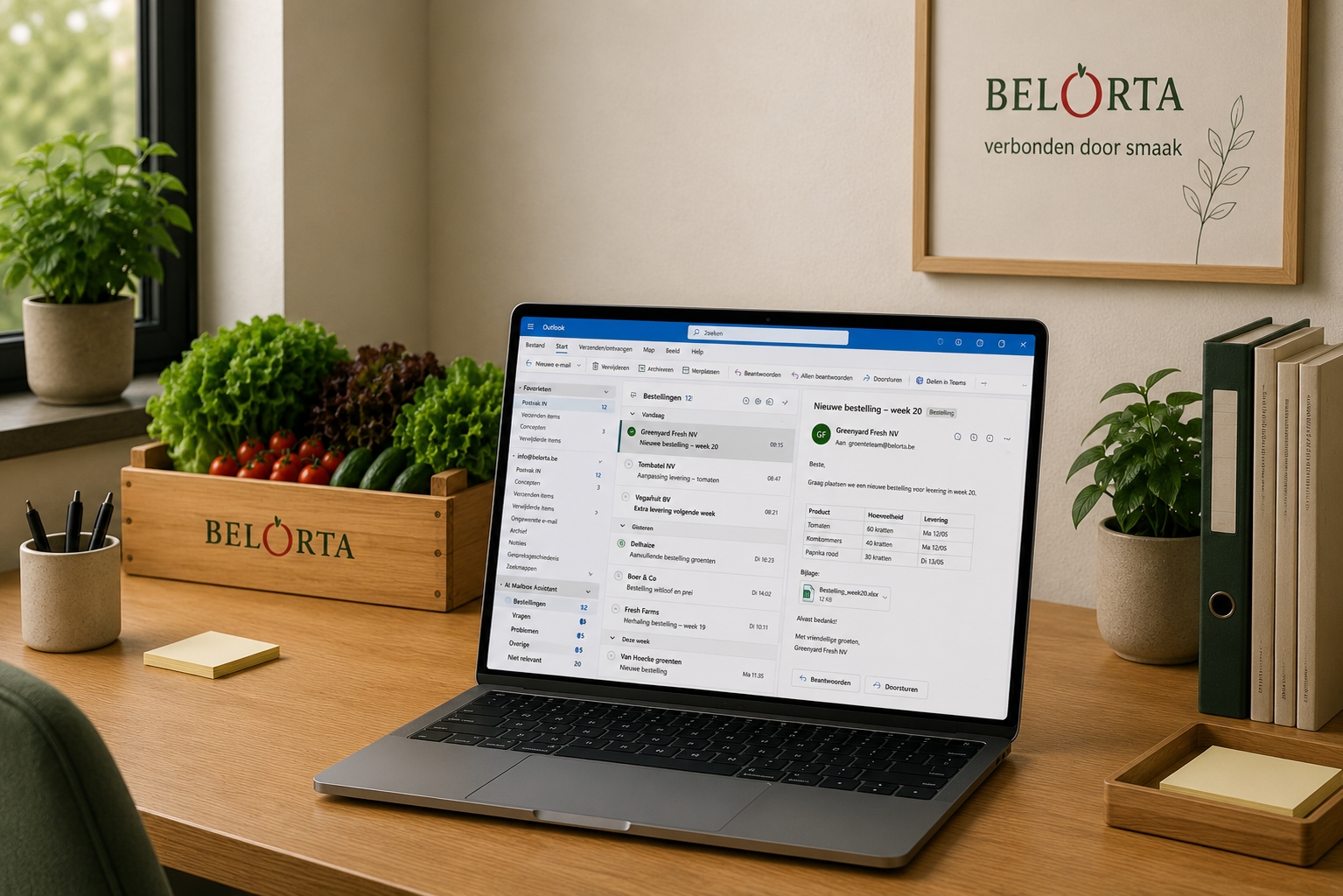
In collaboration with competence center Cloudway, an AI Mailbox Assistant was developed that could be fully integrated into the existing Outlook environment. No new platform was introduced and employees did not have to change their way of working. The intelligence was added behind the scenes.
The AI Mailbox Assistant automatically analyzes every incoming email. In doing so, the system not only looks at the content of the email itself, but also at the attachments. PDF files, Excel documents and even images are read to detect relevant information.
Based on that analysis, the assistant first determines whether the e-mail belongs in the mailbox in which it arrived. A fruit order in the organic mailbox? Then it will automatically be marked as irrelevant to bio. A vegetable order in the fruit mailbox? This is also correctly recognized and labeled.
In addition, each relevant email is categorized in terms of content. Is it a new order, a question about an existing order or a complaint? The assistant automatically places the e-mail in the correct folder. This creates immediate structure in the mailbox, without manual intervention.
The content of the emails and attachments is treated strictly confidentially: the data remains within the BelOrta environment, is not shared with other organisations and is not used to further train external AI models.
Business logic over theory
An important complexity was in the product classification. What is fruit and what is vegetables? Botanically, a tomato is a fruit. However, in BelOrta's daily operations, a tomato is treated as a vegetable, because customers and employees experience it that way.
During the project, several such exceptions emerged. The AI solution was therefore not trained purely theoretically, but tailored to BelOrta's business reality. Today, the system understands how BelOrta itself categorizes its products and acts according to that logic.
That makes the difference between a generic AI model and a solution that really fits the operational operation of the organization.

Concrete impact in the workplace
The AI Mailbox Assistant runs completely in the background. For employees, hardly anything changes their way of working. They will continue to work in Outlook as they normally would. The difference is in what they no longer must do: sorting manually.
In addition, a clear daily overview is created: how many new orders have been received? How many questions need to be answered? Are there any complaints that require priority? This insight not only supports operational operation, but also capacity planning and reporting.
A pragmatic AI application with immediate value
The AI Mailbox Assistant at BelOrta shows that artificial intelligence does not have to be a large, disruptive project to make an impact. By organizing an everyday process in a smarter way, the organization gains time, focus and overview.
Without new tools. Without complex change processes. But with a smart layer of intelligence on top of what was already there. Sometimes innovation is not in something completely new, but in making what is already happening every day more intelligent.