


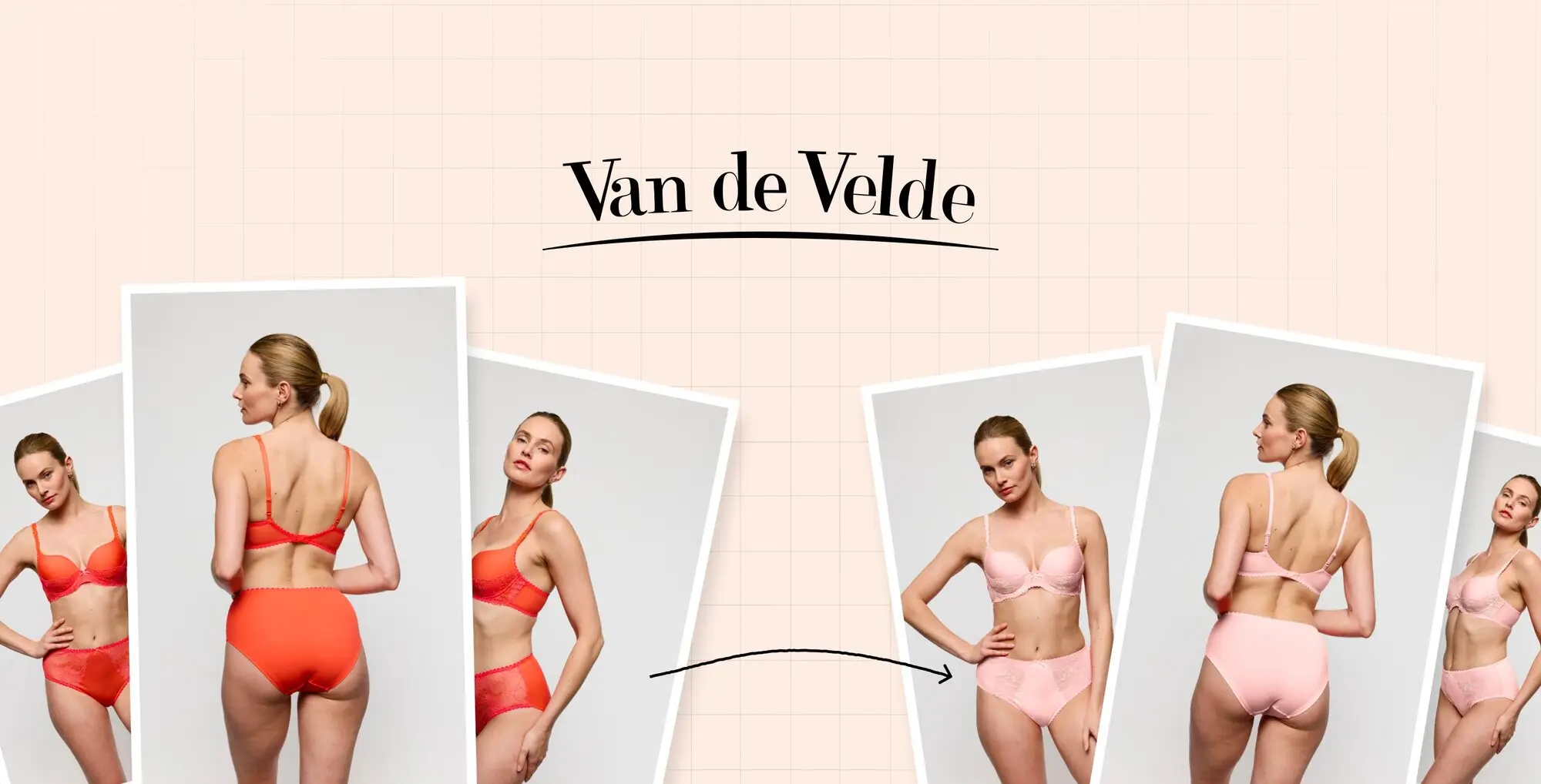
Van de Velde reuses existing photo shoots for new colour variants with Visual AI
- Innovatie
- Artificial Intelligence
- Client
- Van de Velde
- Year
- 2025
- Client
- Van de Velde
- Year
- 2025
- Category
- Innovatie, Artificial Intelligence
- Competence center(s)
- Buzzworks
The challenge: every new colour requires new images
Van de Velde has been making luxury lingerie since 1919. With Marie Jo, Primadonna and Sarda, it sells in about 4000 specialty stores and in its own stores. That network needs thousands of product images.
Series that sell well regularly get new color variants. Each variant requires new packshots and lifestyle images. Van de Velde wanted to know whether AI could expand the existing photo material in a controlled manner, with the quality you expect from a premium brand.
This is exactly where AI image generation often gets stuck. General tools and closed models provide nice demos, but are not consistent enough to use for a brand in production.
The approach: research first, then build
Competence center Buzzworks did not start building immediately. First, there was an R&D phase, with a focus on ethical AI use and quality assurance from the start. This was followed by a proof of concept, in which packshots and marketing images were recoloured.
Based on this, the team built a custom pipeline in multiple steps. It works with open source models, because they offer more control, transparency and customizability and allow for a privacy-first approach. Each recoloring task has its own trained model. Between the steps are QA gates that monitor quality. The first images were assessed on colour-calibrated screens, within the quality process that Van de Velde already had.
In addition to the technology, Buzzworks contributed ideas about how Van de Velde would use the pipeline in practice. Which images and series will be used first, how does the pipeline fit into existing workflows, and what governance agreements are needed as volume grows?
The photo shoots are not going away. They remain the basis: the pipeline complements existing shoot material in a targeted way, it does not replace it.
The result
Ten weeks after the start of the R&D phase, the pipeline was up and running in production. In the meantime, more than 750 images have been taken with it, all at master resolution. Van de Velde now has a scalable capacity that it manages itself. It is embedded in the quality process that was already in place, so the team does not have to follow a separate working method in addition to the existing one.